
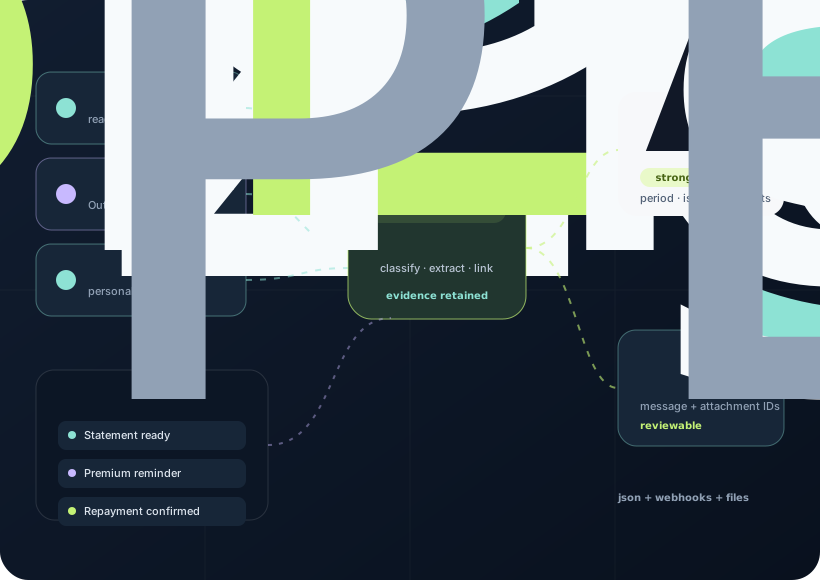
- Financial sender and document classification
- Account, issuer, customer, date, amount, and period extraction
- Thread, attachment, and event relationships
- Changes, anomalies, missing evidence, and exceptions
- Source-linked confidence and review warnings
LeanFintech Inbox
The financial
The financial
inbox, made programmable.
Connect a consented inbox once. Find financial messages and attachments, understand them with AI, and deliver structured records to products, risk models, and operations.
Provider-native, read-only, cross-device financial data infrastructure.
leanfintech.inbox
consented
provider accounts
Gmailpersonal + Workspace
MicrosoftOutlook + Microsoft 365
Zohopersonal + business
Forwardingpurpose-built addresses
Financial intelligence engineClassify, extract, link, explain
policy -> evidence -> objects
product-ready outputs
Documentsstatements + notices
Signalsincome + obligations
Eventschanges + exceptions
Evidencesource-linked fields
read_only: truejson + webhook + files
Built from working financial inbox infrastructure
Provider OAuth
Historical search
Attachment retrieval
Inbound email
Structured delivery
One connection, governed by policy
Mailbox access is plumbing. Inbox turns it into financial infrastructure.
Connect, define purpose, understand the permitted data, and deliver only what the product needs.
- Connect
Use provider-native OAuth or a purpose-built forwarding address.
- Scope
Define permitted sources, dates, fields, and processing purpose.
- Understand
Classify, extract, connect related events, and retain evidence.
- Deliver
Return normalized JSON, files, confidence, warnings, and webhooks.
Financial ontology, not generic email summaries
Turn messages into objects your product can reason about.
Every extracted field can retain its source message, attachment, evidence, and confidence.
{
  "object_type": "financial_document",
  "document_type": "account_statement",
  "issuer": "Example Bank",
  "period": { "from": "...", "to": "..." },
  "amounts": [],
  "signals": [],
  "confidence": "strong",
  "evidence": {
    "message_id": "...",
    "attachment_id": "..."
  },
  "warnings": []
}
One product, many financial workflows
Use the inbox history customers already have.
Inbox is a horizontal infrastructure layer. Each product chooses its own sources, objects, analysis, and delivery contract.
Wealth and investments
Find CAS statements, broker communications, contract notes, insurance records, tax documents, and portfolio notices.
Lending and underwriting
Collect permitted evidence of income, obligations, statements, repayments, financial accounts, and recurring commitments.
Personal finance
Build account, card, loan, insurance, subscription, bill, and investment views from financial communications.
Insurance
Understand policy documents, premium notices, renewals, claims communications, and coverage changes.
Tax and compliance
Collect permitted statements, certificates, notices, identity records, and supporting documents into review workflows.
Fintech operations
Route messages, attachments, exceptions, missing records, and source changes into operational queues and systems.
Why Inbox
Account-linked intelligence without device surveillance.
Different acquisition methods solve different problems. Inbox is strongest when documents, history, and future financial communications matter.
| Approach | Coverage | User dependency | Best fit |
|---|---|---|---|
| Manual upload | One selected file | Find, download, upload | Known document |
| Device / SMS SDK | On-device signals | App, device, OS permissions | Mobile behavior and transaction alerts |
| Account Aggregator | Participating financial sources | AA consent flow | Standardized institution data |
| LeanFintech Inbox | Financial messages, documents, and history | Provider OAuth or forwarding | Cross-device financial context and ongoing events |
Financial intelligence needs a defensible boundary.
Inbox is designed around explicit provider consent, read-only access, purpose limitation, revocation, configurable retention, and source-linked evidence.
- No SMS, location, call-record, or contact-list permission required
- Provider account access works across the customer's devices
- Policies constrain the sources and analysis used by each product
- Customer-controlled disconnection and deletion workflows
- Auditable message, attachment, extraction, and delivery references
Bring the financial questions your product needs to answer.
We will map the provider connection, permission boundary, financial objects, AI analysis, evidence, delivery contract, and operating controls.
Design your Inbox productWhat financial intelligence is sitting in your customers' inboxes?
Turn the answer into a governed API, product feature, risk signal, or operations workflow.
Questions
Inbox, answered.
What teams ask before they connect the first inbox.
What is LeanFintech Inbox?
Inbox is consented financial inbox intelligence. It connects Gmail, Microsoft, and Zoho accounts, scopes and understands the financial messages and attachments users permit, and delivers structured objects, evidence, and events your product can reason about.
How is Inbox different from a device or SMS SDK?
Inbox uses provider-native, consented, read-only account access. It does not require SMS, location, call-log, or contact permissions, and it works across devices because it reads from the mailbox rather than the phone.
What data does Inbox return?
Inbox returns structured financial objects with source links, confidence scores, warnings, and events, rather than raw mailbox text.
Which inbox providers does Inbox support?
Gmail, Microsoft, and Zoho, plus a forwarding address for financial messages that arrive outside a connected account.
Is inbox access read-only and revocable?
Yes. Access is consented, read-only, purpose-limited, and can be revoked by the user at any time.